Our Rover
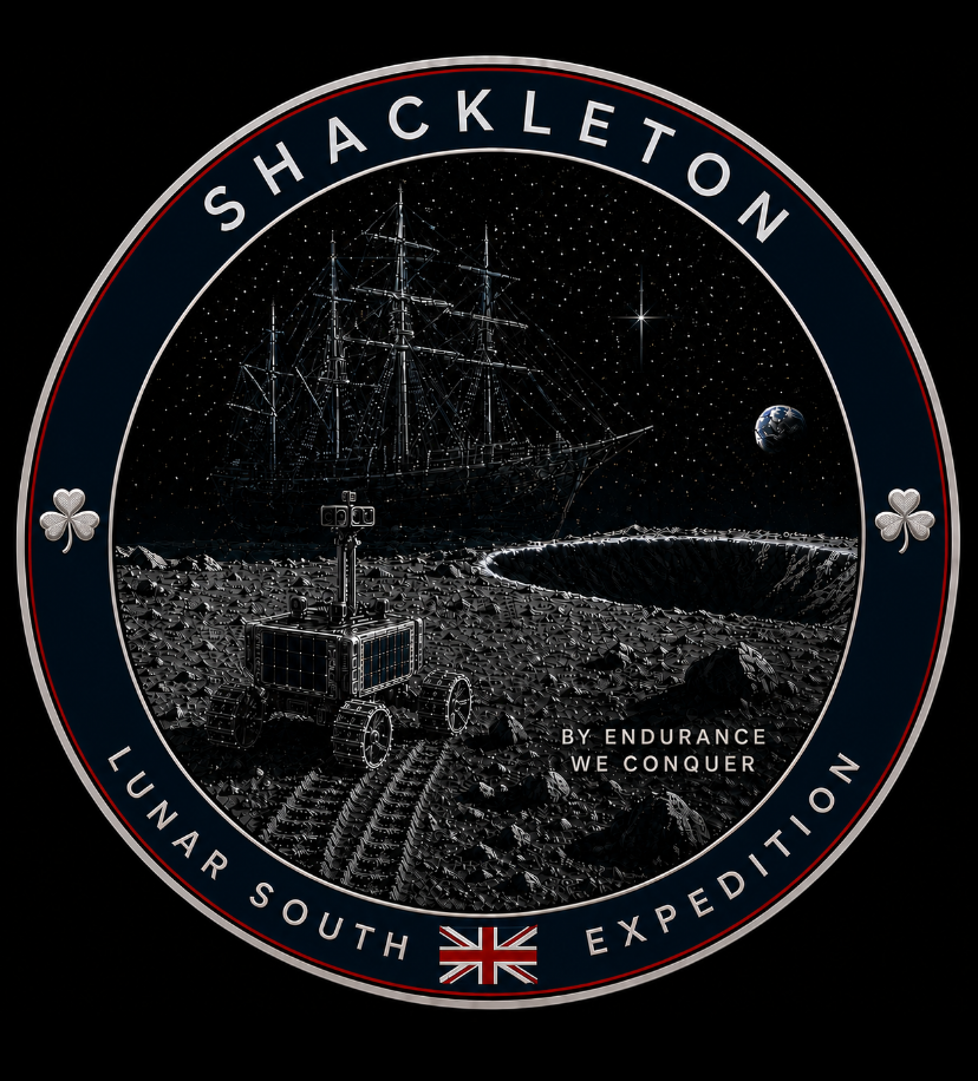
The rover will have four-wheel skid steering, an extendable vertical mast for illumination and communications, and an exploration payload. The chassis will have solar panels and contain a battery and phase-change pack sized to permit one-hour sorties to the shadowed regions followed by a ten-hour recovery window.
Architecture
Shackleton Rover is a compact four-wheel rover platform capable of traversing uneven regolith, shallow crater terrain, and transition zones between illuminated and shadowed regions. This architecture builds upon the UK’s long heritage in planetary robotics and autonomous systems, including technologies developed for the Rosalind Franklin Mars rover programme.
Communications
Communications will be S-band to the lander via a directional patch antenna mounted on a deployable vertical mast with yaw control. The mast will provide illumination and down-looking imagery for path planning in difficult terrain and low-angle lighting conditions. This type of mast is made in the UK by companies such as Rolatube.
Exploration
The rover carries a sonicated penetrator system intended to investigate volatile-bearing material beneath the lunar surface without conventional rotary drilling. Stepped heating will drive liberated volatiles towards an ion-trap mass spectrometer, allowing discrimination between adsorbed water, pore ice, ice-cement, and associated compounds within the regolith.
Drilling requires large forces and generates a lot of torque. This can be reacted by heavy structures on the Earth, but in low-gravity environments such as the Moon a surprising problem arises. Without significant weight, forcing a drill downwards may simply drive a rover upwards, and rotating that drill in the ground may make the situation even worse.
This is a problem. Our target - the water ice - may be underground, so drilling is essential. This is why many of our competitors are proposing larger rovers, up ten times heavier than Shackleton. The extra weight will make the force and traction problems more manageable.
The alternative is to have tools that will seek to explore only on the surface, or within the top 10cm or so.
However, larger and more expensive rovers cannot easily be delivered by fast commercial services. And limiting the depth of our exploration reduces our chances of success.
Therefore, Shackleton will be different. Our target mass is just 20kg, but we will equip our rover with unique technologies that will allow it to access the subsurface using much smaller forces. We will use ultrasonic penetrators to fluidise the lunar soil, so that we can penetrate it more easily; and we will use non-rotating drills to eliminate the need to spin heavy drillstrings in space. The UK leads with both of these enabling technologies.
This will allow us to drill deeper from a smaller platform. It will also allow us to demonstrate the highly efficient earth-moving tools that will be needed to underpin the construction of bases, the prospecting for resources, and the manufacture of lunar concrete in the future.
When penetrating granular materials, everyone instinctively understands that you need to wiggle a tool to make it slide in more easily. This is because small movements disrupt the load-bearing chains of particles that transmit force from the tool to the far-field.
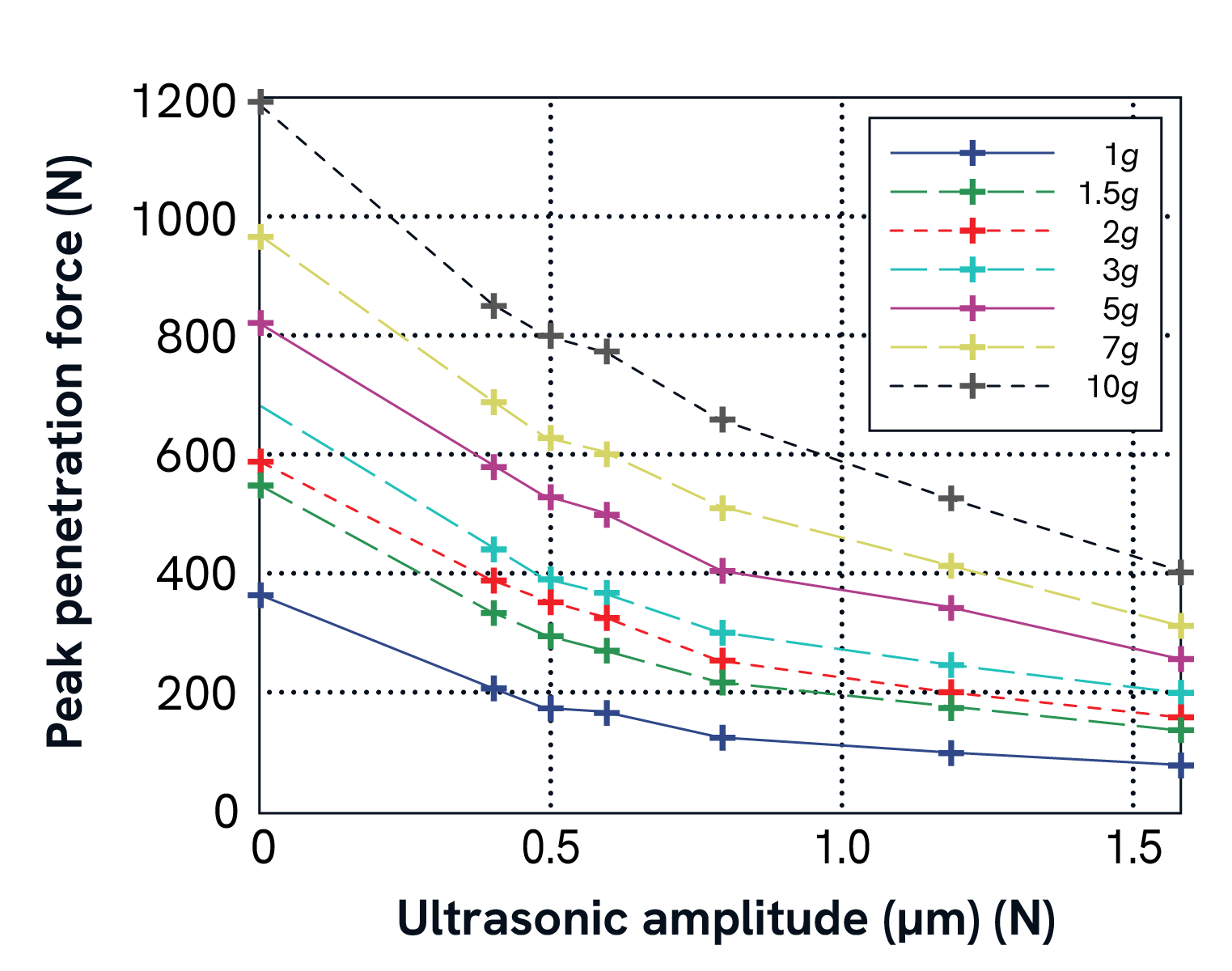
Research in the UK has indicated that this movement can be applied at the micron scale using ultrasonic vibration, fluidising granular materials and reducing the force required to penetrate a solid-state device by up to an order of magnitude.
This effect has been observed in ambient and hypergravity (see figure), in reduced gravity, and in vacuum. It has the potential to make the subsurface available to rovers such as Shackleton, which are at least an order-of-magnitude smaller than other currently-concieved platforms such as VIPER and LUPEX/Chandrayaan-5.
Should the risk of ice-cemented ground be too high for a fluidising penetrator to operate, there are alternatives.
One concept is the pulse-elevator, which uses an oscillating Tesla-valve geometry to drill without the need for any rotation.
The oscillation provides a hammer action, with the vibration load being smooothed by a mass-damper. However, there is still the issue of extracting the spoil from the hole. This is usually done with an auger, but Shackleton is simply not big enough to react the torque required.
Therefore, instead of being lifted in an auger, a pulse-elevator lifts the spoil internally. On the downstroke, the device moves faster than uplifted spoil can fall, so it rises inside the Tesla-valve features. On the upstroke the spoil becomes locked in place. This means that the spoil is swept to the top of the device as a side-effect of the hammer action itself.
The pulse-elevator can also be formed into any combination of horizontal and vertical paths, meaning that it is more flexible than a rigid-rotating auger. The concept has been tested using regolith simulants and in vacuum, where it continues to work well.
The pulse-elevator is a priority technology which already sits on the UK space exploration technology roadmap.