Our Expedition
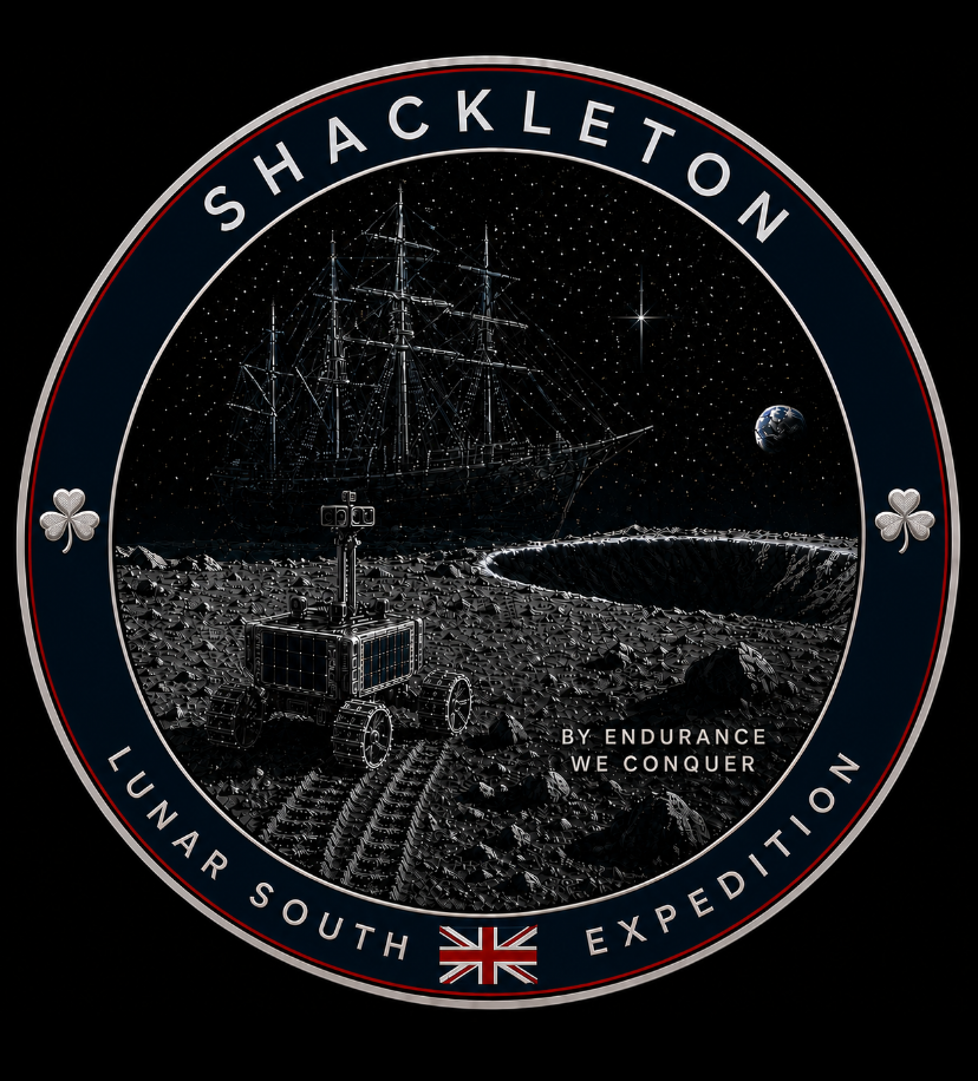
The Shackleton Rover is a British robotic expedition to the lunar south pole, in pursuit of the first ground truth for lunar water ice. We know this ice exists in the permanently shadowed regions of the Moon, but almost nothing about its nature: it could be surface frost, buried deposits, or something more like glacial ice. Shackleton will go there, drill into the ground, and find out. Understanding the form, depth, and distribution of this ice is a critical step towards understanding the Moon’s most important natural resource.
Why Water Ice?
Fuel and oxidiser make up more than 90% of the weight of any rocket launch. Water ice on the Moon could be broken into hydrogen and oxygen, which are ideal rocket propellants, so that they would not need to be launched from Earth itself. Just as the early polar explorers relied on forward-deployed supply caches along their route, the ability to refuel our rockets in space would be transformational for the exploration of the solar system.
Why the South Pole?
The Moon has permanently shadowed regions near the poles, such as craters, where sunlight never reaches. These regions become very cold and preserve ice for long periods of time. However, the lips of the same crater can be exposed to permanent sunlight. We can use the sunlight to generate the electricity we need to explore the shadowed regions, and subsequently to electrolyse the ice we find into hydrogen and oxygen.
Why Shackleton?
Sir Ernest Shackleton's Endurance expedition has inspired ambition, leadership, and moral optimism for more than a century. This mission carries that ethos into space. To underline this, our mission will carry a small fragment of the RRS Discovery to the Moon. Just as pieces of the Wright Flyer have travelled to Mars aboard robotic helicopters, Shackleton Rover will carry our exploration heritage to a new polar frontier in space.
Some major questions about the nature of water and other volatiles on the Moon, as well as the properties of the terrain that bears them, can only be answered on the ground. We have an opportunity to achieve a scientific success of global significance.
More practically, many nations are planning their first lunar enterprises, and they will need expertise in prospecting, refuelling and autonomous operations. Shackleton Rover will develop UK capability in all three. We will become a partner of choice in earth-moving and regolith handling. We will demonstrate that we can find volatiles, whether on the surface or below it, and that we can do so from small, highly autonomous platforms. This know-how will position Britain to participate in an emerging lunar economy that is estimated to be worth around $5bn in Europe alone in less than ten years.
We will also demonstrate that the UK can operate on the lunar surface, complementing our existing expertise in descent engines and communications. Establishing a near full-spectrum capability will give Britain the credibility required to help shape the regulation of space resources, drawing on the best traditions of the Antarctic Treaty System.
Most importantly, however, will inspire optimism and ambition. We will demonstrate that Britain can lead the world in engineering, exploration, and discovery.
We will pursue an aggressive schedule, with the aim of having students develop their careers alongside the mission. These enormously capable people, who will learn how to build and operate space exploration hardware at the edge of what is possible, will add value to our society for decades to come.
However, we need to move quickly. There is a short period in which scientific and economic outcomes of global significance can be delivered by a small rover using our specialised exploration tools. Better-resourced nations are developing larger systems, and our advantage will not last indefinitely. At the same time, the regulation of lunar activity is beginning to take shape, while Britain still has the opportunity to lead by example.
This combination of opportunities: technological, industrial, impactful, and inspirational, will not arise again. We must choose to take them now, if we are going to take them at all.
The Shackleton Rover concept is will showcase responsible exploration. The mission draws deliberate inspiration from the history of Antarctic exploration: scientific ambition combined with real endurance, cooperation, and long-term stewardship of the environment.
We will therefore develop useful technologies. As humanity establishes bases on the Moon, we will need earth-movers and concrete, as well as rocket propellants. Our low reaction exploration tools will allow us to compete with missions ten times larger than our own. This gives us an advantage over the more costly missions proposed by our competitors.
However, we will always return to the established model of co-operation which works so well In Antarctica. For example, we will have alternate driver teams, based in Canada and Australia, to cover unsociable hours and hence maintain constant operations on the Moon.
The Antarctic Treaty System establishes Antarctica is as an international reserve devoted primarily to science. The UK is a founding member of this system, and its success has been clear: global issues such as ozone depletion and wildlife conservation have been successfully addressed.
The Antarctic Treaty System is itself guaranteed by the physical presence, on the ground, of its consultative states. These are parties, such as the UK, which are recognised by their peers as having demonstrated a significant capability to operate independently in Antarctica.
We can achieve the same outcome on the Moon. The UK has the convening power, on the world stage, to make the case for a new global commons which does not prohibit the pursuit of resources. Shackleton Rover will provide the physical statement of intent that we will need to translate this proven model of sound environmental governance to a new world.
Land near the lunar south pole
Arrive by CLPS or a similar commercial delivery service, targeting sunlit terrain near a shadowed region.
Traverse to shadowed sites
Use a small rover platform to reach promising exploration locations that static landers cannot easily access.
Probe the regolith
Deploy a sonicated penetrator to investigate volatile-bearing material beneath the lunar surface.
Repeat
Return to the sunlight to recharge batteries and then sortie to the next exploration site.