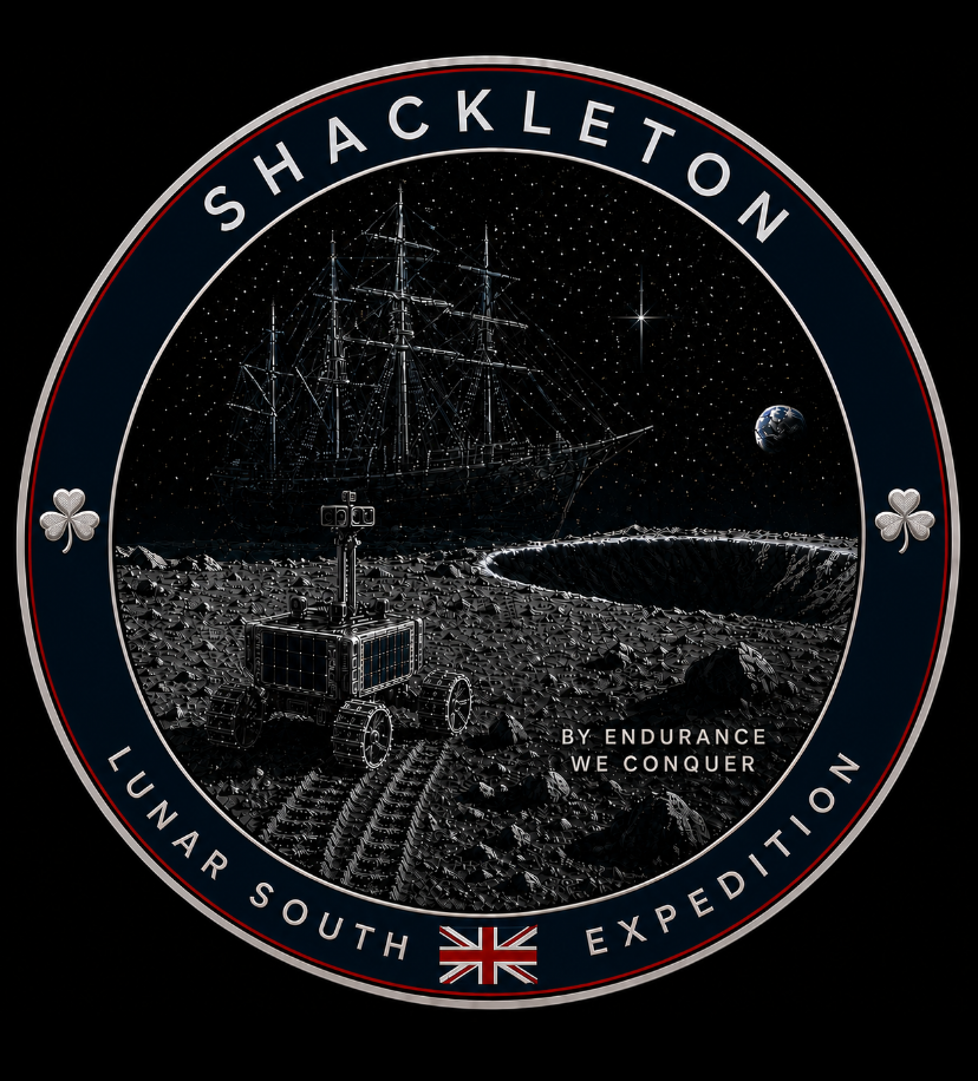
The Shackleton Rover is being built around contributions from organisations
that share our ambition to explore the lunar south pole and demonstrate what
British science, engineering and exploration can achieve.
CAVU Aerospace is a Stirling-based space engineering company specialising in
command-and-data-handling electronics, particularly onboard computers (OBCs),
thermal-control units, payload interfaces and imaging hardware for satellites,
spacecraft and launch vehicles.
CAVU Aerospace will contribute a suitable flight computer and thermal-control
system to the Shackleton Rover, with specifications to be agreed during the
technical development of the mission.
“We are delighted to be able to support the Shackleton Rover project.
Providing the onboard computing and thermal-control hardware is an opportunity
to put CAVU’s technology at the heart of an exciting mission, and to
demonstrate what our space sector can contribute to lunar exploration.”
A fragment of RRS Discovery will be carried to the lunar south pole as part
of the proposed Shackleton Rover expedition.
Built in Dundee for the British National Antarctic Expedition of 1901–04,
Discovery was the ship that first carried Ernest Shackleton to Antarctica.
More than 125 years later, a small piece of the ship will travel with the
Shackleton Rover to another south pole.
“RRS Discovery first carried Ernest Shackleton south to Antarctica in 1901.
It seems wonderfully appropriate that a small part of the ship should now make
another journey south, this time to the Moon.
“When NASA sent the Ingenuity helicopter to Mars, it carried a fragment of
the Wright brothers’ original Flyer, connecting the first powered flight on
Earth with the first on another world. Carrying a fragment of Discovery aboard
Shackleton will make a similar connection between two eras of exploration.”